

Organic Fertilizer Market Set to Surge to USD 15.6 Billion by 2033 on Sustainable Agriculture Boom | Study by Market Minds
Soil health restoration, carbon farming incentives and residue-free food demand are bolstering adoption of organic nutrient solutions. Organic fertilizer market is evolving from traditional manure into high-efficiency liquid biostimulants that enhance nutrient uptake and soil health.
London, UK, Feb. 23, 2026 (GLOBE NEWSWIRE) -- The organic fertilizer market is expected to expand from USD 9.4 billion in 2026 to USD 15.6 billion by 2033, registering a CAGR of 7.6% during the same period. Demand is propelled by the global transition toward regenerative agriculture, soil microbiome enhancement, and reduced chemical dependency. The transition toward soil carbon sequestration and chemical-free produce is driving the sales. Modern fertilizers are sophisticated, incorporating microbial inoculants and precision-delivery technologies that allow for nutrient release profiles comparable to conventional options, making them viable for large-scale commercial farming. Farmers are increasingly adopting organic nutrient inputs to improve soil structure, moisture retention, and long-term crop productivity.
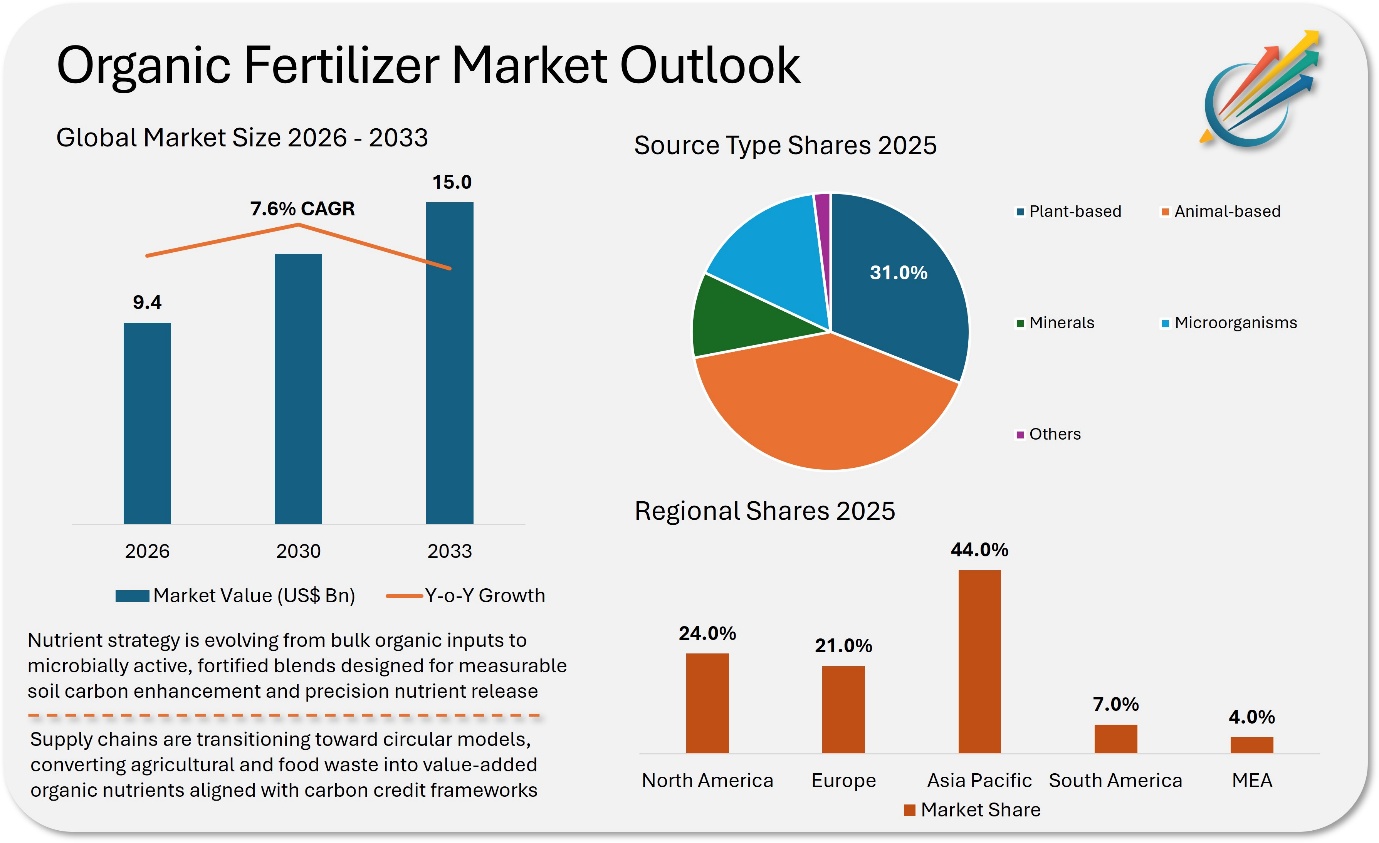
Tightening regulations on synthetic fertilizers, carbon credit mechanisms, and growing consumer demand for residue-free food products is fostering organic fertilizer market growth. Governments across North America, Europe, and Asia-Pacific are incentivizing sustainable farming practices through subsidies and certification programs. Technological advancements in composting, bio-digestion and nutrient fortification are improving product consistency and yield efficiency. Organic fertilizers increase soil organic matter, allowing farmers to monetize carbon credits. The market is characterized by a move toward circular economy models, where food waste and industrial by-products are upcycled into high-value agricultural inputs. This secures the supply chain and addresses the rising demand for clean label produce among global consumers.
Request a Sample Report to Explore Key Market Insight: https://marketmindsadvisory.com/request-sample/?report_id=16300
Key Takeaways from Organic Fertilizer Market
- Organic fertilizer market size is projected to reach USD 15.6 billion by 2033, growing at an annualised growth rate of 7.6% over the forecast period.
- Animal-based organic fertilizer remains a prominent source due to its widespread availability and high nitrogen content.
- Liquid organic formulations projected to be a fast-growing form during the forecast period due to their compatibility with modern fertigation systems.
- Brazil and India are emerging as key investment centers, driven by massive government subsidies for organic clusters and export-oriented high-value crops.
- Competition is influenced by traditional chemical fertilizer giants acquire specialized biotech firms to build out green product portfolios.
- Rising demand for specialty organic fertilizers for indoor vertical farming and urban greenhouses is creating new, high-margin value pools.
- Biofertilizers and fortified organic blends projected to a key segment over the coming years.
Market Dynamics Shaping the Organic Fertilizer Market
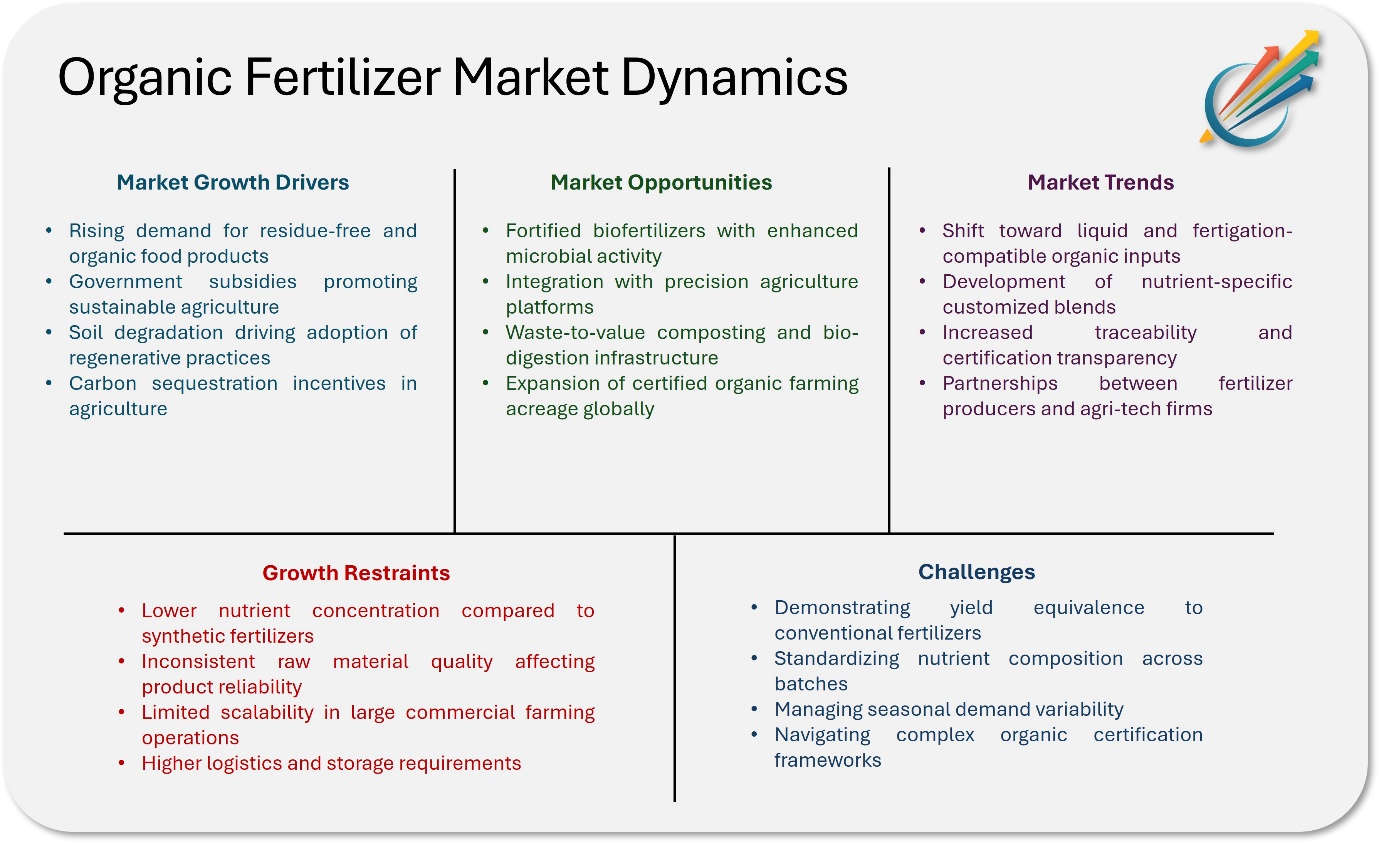
Soil health restoration and sustainable agriculture policies boosting organic fertilizer market
Soil degradation, nutrient depletion and declining crop yields are prompting farmers to adopt organic nutrient management practices. Governments are realizing that food security is inherently tied to soil health, leading to mandates that encourage the use of organic inputs. Organic fertilizers improve soil microbial activity, enhance organic matter content, and reduce environmental runoff. With climate variability impacting agricultural productivity, soil resilience has become a strategic priority. Integration of organic fertilizers into regenerative farming models is reinforcing long-term sustainability and crop stability, positioning the organic fertilizer market for steady expansion over the forecast period.
Purchase the Full Market Report with In-Depth Analysis & Forecasts: https://marketmindsadvisory.com/buy-now/?report_id=16300
Carbon credits and circular waste utilization creating ample opportunities for the organic fertilizer market
Emerging carbon credit frameworks are creating monetization pathways for farmers adopting organic soil inputs. Organic fertilizers contribute to carbon sequestration and reduced greenhouse gas emissions compared to synthetic alternatives. Additionally, agricultural waste, livestock manure, and food processing by-products are being converted into value-added nutrient solutions. As urban centers struggle with waste management, the ability to convert municipal bio-waste or food processing by-products into standardized, pathogen-free organic fertilizer is creating ample business opportunities. This circular economy approach reduces waste disposal costs and enhances farm-level profitability bolstering position in the organic fertilizer market.
Nutrient variability and yield performance concerns impacting organic fertilizer market growth
Despite environmental benefits, organic fertilizers often exhibit lower nutrient concentration and slower nutrient release compared to synthetic options. Variability in raw material quality can impact consistency and farmer confidence. Logistics and storage challenges also limit scalability for organic fertilizer market growth in certain regions. Moreover, transitioning from conventional to organic farming requires adaptation in crop management practices. Also, transporting large volumes of organic matter is costly and energy-intensive, which can erode the green value proposition.
Organic Fertilizer Market Segmentation
By Source
- Plant-based
- Molasses
- Seaweed
- Soybean Meal
- Legume Cover
- Cottonseed
- Green Manure
- Others
- Animal-based
- Fish Emulsion
- Bone & Blood Meal
- Urea
- Manure
- Others
- Minerals
- Microorganisms
Animal-based fertilizers such as, poultry litter and bone meal are a prominent source type in organic fertilizer market due to widespread availability of manure and strong nutrient content. Plant-based products are gaining traction among certified organic producers seeking residue-free inputs. Mineral-based organic formulations serve niche soil correction needs. Source selection influences nutrient balance, cost structure, and certification compliance. Increasing focus on traceability and pathogen-free processing is shaping procurement standards across agricultural supply chains.
By Formulation Process
- Composting
- Anaerobic Digestion
- Fermentation
- Others
Composting remains the most prevalent process in the organic fertilizer market, supported by cost efficiency and scalability. Anaerobic digestion is expanding due to biogas integration and waste-to-energy benefits and is expected to remain fastest growing process over the coming years. Fermentation technologies are being adopted for biofertilizer production with enhanced microbial activity. Process innovation is improving nutrient stability and shelf life. Manufacturers are investing in controlled processing environments to ensure consistent quality and regulatory compliance.
By Nutrient Content
- Ammoniacal Nitrogen Fertilizer
- High Organic Matter
- Humus-Rich Soil Improver
- Others
Nitrogen-rich organic fertilizers account for a key share in organic fertilizer market, reflecting crop demand for primary macronutrients. Multi-nutrient blends are projected to grow fastest as farmers seek balanced soil enrichment. Phosphatic and potassic organic products cater to specific crop and soil deficiencies. Customized nutrient formulations are gaining adoption in precision agriculture frameworks and nutrient optimization remains central to enhancing yield performance and farmer acceptance.
By Form
- Powder
- Granules
- Pellets
- Liquid
Dry formulations dominate due to ease of storage and transportation majorly considering the power and granules form. However, liquid organic fertilizers are witnessing faster growth owing to improved absorption and compatibility with modern irrigation systems. Liquid formats support fertigation and precision nutrient delivery. The shift toward drip irrigation and controlled farming environments is accelerating demand for soluble organic inputs in the organic fertilizer market.
By Crop Type
- Cereals & Grains
- Fruits & Vegetables
- Oilseeds & Pulses
- Turf & Ornamentals
- Others
Cereals and grains accounts for the majority of the demand for organic fertilizer due to extensive cultivation areas. Fruits and vegetables are experiencing faster growth, driven by rising demand for organic produce. Oilseeds and pulses benefit from soil enrichment properties of organic inputs. Crop-specific nutrient management is shaping product development strategies in the organic fertilizer market. High-value horticulture markets are increasingly adopting premium organic formulations.
By Application
- Soil Treatment
- Seed Treatment
- Foliar Application
- Gardening
Soil treatment is the prominent application in organic fertilizer market ensuring gradual nutrient release and soil conditioning. Fertigation is projected to grow rapidly as irrigation infrastructure modernizes. Foliar spray applications serve targeted nutrient supplementation needs. Application method selection depends on crop type, soil condition, and farm size. Integration with precision farming tools is enhancing efficiency and reducing input wastage.
By Region
- North America
- Europe
- Asia Pacific
- South America
- MEA
Asia-Pacific accounts for majority of demand in organic fertilizer market, with India promoting organic farming under national sustainability programs and China expanding eco-friendly agriculture initiatives. Key Asia countries are pivoting to organic inputs to reduce their massive import bills for synthetic fertilizers and to combat severe soil salinization and are focusing on agricultural modernization and policy incentives. North America remains a strong adopter, particularly in the United States, supported by consumer demand for organic food products and innovation focus on high-tech liquid formulations for the premium horticulture market. Europe, led by Germany and France, continues to emphasize regulatory backing for sustainable inputs. The organic fertilizer market in Latin America is exploding as a response to the export green movement, where producers are using organic fertilizers to gain premium access to European markets for soy and coffee.
Need tailored insights? Request for a customization report: https://marketmindsadvisory.com/request-customization/?report_id=16300
Competitive Landscape – Organic Fertilizer Market
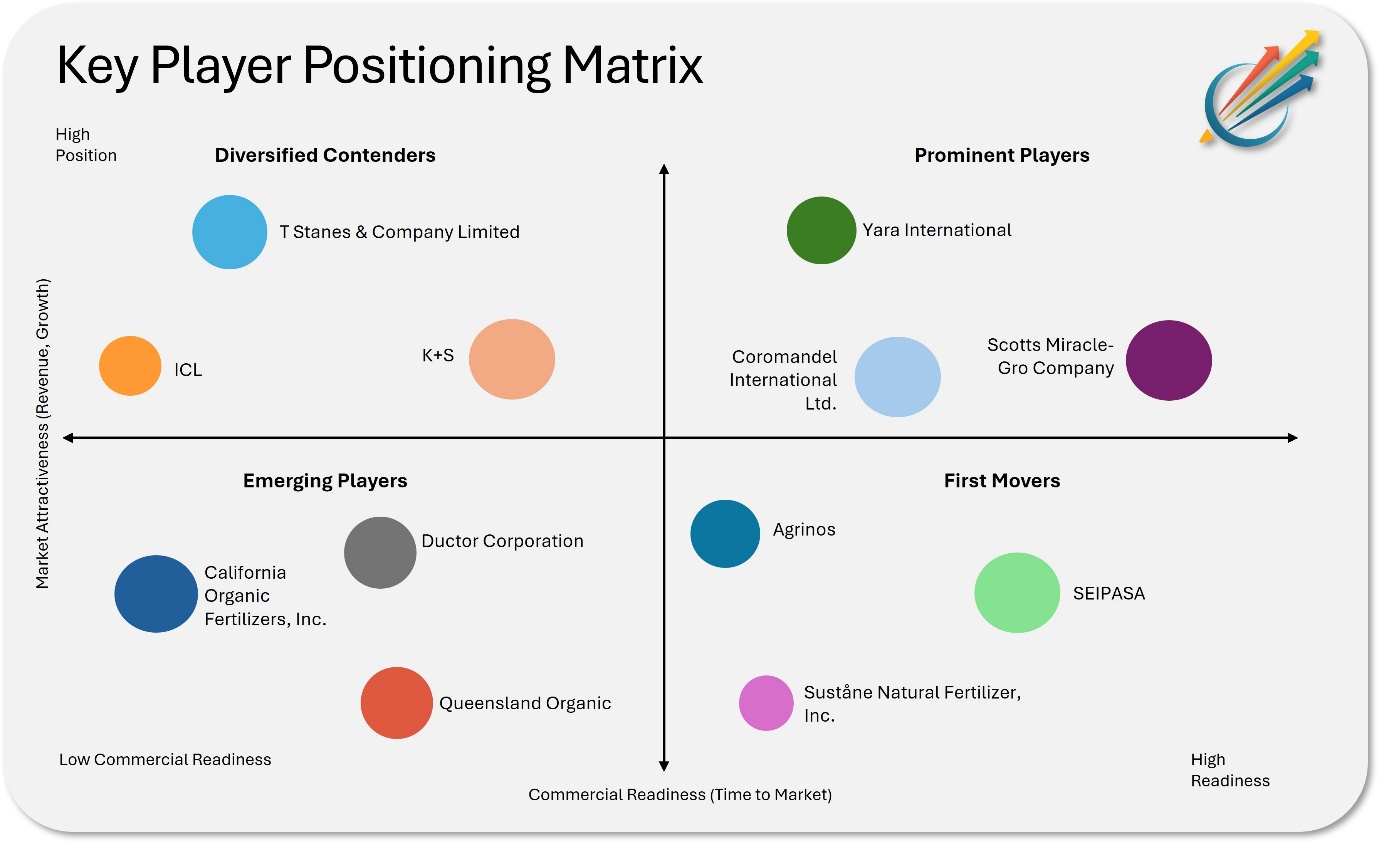
Leading companies are expanding composting and bio-digestion capacities, investing in fortified nutrient blends and forming partnerships with agricultural cooperatives. Strategic acquisitions are strengthening regional distribution networks in the organic fertilizer market. Key players are focusing on forward and backward chain integration where companies are securing their own organic waste sources (like partnerships with large-scale poultry farms) to ensure raw material consistency. Leading firms are also investing heavily in product developments to incorporate biostimulants such as, mycorrhizal fungi and seaweed extracts into their organic fertilizers to provide all-in-one soil health solution.
Key Players in Organic Fertilizer Market are
- K+S
- Coromandel International Ltd.
- SPIC
- T Stanes & Company Limited
- TerraLink Horticulture Inc.
- Midwestern BioAg
- Suståne Natural Fertilizer, Inc.
- Fertoz Ltd.
- Queensland Organic
- Ductor Corporation
- Scotts Miracle-Gro Company
- California Organic Fertilizers, Inc.
- Espoma Company
- Yara
- ICL
- Perfect Blend, LLC
- FKL Fertilizers
- FertPro Manufacturing Pty Ltd
- Biostar Renewables, LLC
- Cropmate Fertilizers Sdn Bhd
- Biolchim Spa
- Agrinos
- SEIPASA
Key Developments:
- In December 2024, Yara International expanded its YaraSuna portfolio further, reinforcing its ambition to lead Europe’s circular nutrient segment through strategic alliances with waste management partners to secure consistent organic feedstock streams.
- In April 2025, BSOG Energy & Unigrains Trading formed a €65 million partnership to build Romania’s first combined biomethane and organic fertilizer facility, targeting over 250,000 tons of annual production.
- In December 2024, Hello Nature opened a 300,000 sq. ft. bio-nutrients facility capable of producing 150,000 tons of chicken manure-based fertilizers annually.
- In December 2023, Yara finalized the acquisition of Italy-based Agribios, strengthening its organic fertilizer manufacturing capabilities and enhancing its footprint in the European sustainable inputs market.
- In April 2025, Equitix completed the acquisition of UK-based anaerobic digestion operator Bio Capital, underscoring growing investor interest in bioenergy-linked nutrient recovery and circular agriculture infrastructure.
Browse the Complete Research Report: https://marketmindsadvisory.com/organic-fertilizer-market/
Trending Related Reports
The global biostimulants market is expected to grow significantly, with a robust CAGR of 11.8% during the forecast period from 2024 to 2034.
The global bioenzyme fertilizer market is poised for robust growth, with a projected CAGR of 9.9% from 2024 to 2034.
The fertilizer additives market is poised for significant growth, with an estimated valuation of USD 1,168.62 million in 2025, projected to reach approximately USD 1,962.88 million by 2035, at a steady 5.2% CAGR.
The global water-soluble fertilizer market is poised for significant growth, with the market value projected to increase from USD 18,623.1 million in 2025 to USD 34,080.9 million by 2035, reflecting a 7.5% CAGR.
The demand for Microalgae-based Fertilizers Market in the fertilizers sector is forecasted to achieve a valuation of USD 12 million in 2024, reflecting an increase from previous estimates.
The global green fertilizer market is expected to witness substantial growth, increasing from USD 2,223 million in 2025 to USD 3,442.6 million by 2035, registering a steady CAGR of 5.5% during the forecast period.
The global urea formaldehyde market is projected to grow steadily, reaching USD 34.12 billion in 2025 and USD 42.57 billion by 2035, with a CAGR of 2.8% over the forecast period.
The global sulphur coated urea market is projected to grow from USD 1,051.2 million in 2025 to USD 1,454.0 million by 2035, reflecting a steady CAGR of 4.3% during the forecast period.
The global rodent control pesticides market is projected to achieve significant growth, with an estimated valuation of USD 7 billion in 2025, expected to reach USD 13 billion by 2035. This reflects a robust CAGR of 7.8% over the forecast period.
The Herbicides market is anticipated to grow at a CAGR of 7% during the forecast period, with its valuation projected to rise from USD 39.54 billion in 2025 to USD 72.02 billion by 2035.
Why choose Market Minds Advisory
Market Minds Advisory delivers decision-grade intelligence trusted by executives across machinery & equipment, packaging, chemical, automotive, information & communication technology, food & beverage, consumer goods, healthcare and other industries. We provide market expansion strategies, go-to-market strategies, market share acceleration, brand positioning analysis, and account enablement and growth. Our forecasting methodology integrates primary interviews, proprietary demand models and continuous market validation to ensure accuracy in volatile and emerging industries. With over 10 years of industry experience and insights derived from primary interviews with several industry stakeholders, our research provides actionable insights and white space analysis for the emerging segments providing the opportunity gaps in the market accounting recent market developments and geopolitical risks. We believe in unlocking growth by helping businesses to see the future of their markets.
Contact Us
Market Minds Advisory

86 Great Portland Street, Mayfair, London,

W1W 7FG, England, United Kingdom

T: +44 020 3807 7725

Email: sales@marketmindsadvisory.com
Website: https://marketmindsadvisory.com/
LinkedIn | Facebook | Twitter | Instagram
Attachments

Market Minds Advisory 86 Great Portland Street, Mayfair, London, W1W 7FG, England, United Kingdom T: +44 020 3807 7725 Email: sales@marketmindsadvisory.com

Organic Fertilizer Market
Organic Fertilizer Market Outlook
Organic Fertilizer Market Key Player Positioning Matrix
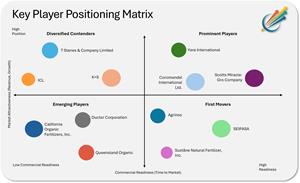
Organic Fertilizer Market Key Player Positioning Matrix
Legal Disclaimer:
EIN Presswire provides this news content "as is" without warranty of any kind. We do not accept any responsibility or liability for the accuracy, content, images, videos, licenses, completeness, legality, or reliability of the information contained in this article. If you have any complaints or copyright issues related to this article, kindly contact the author above.
